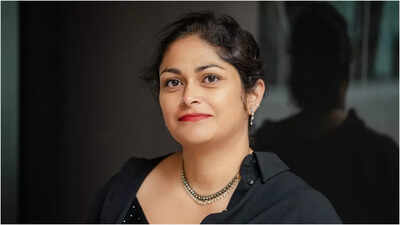
Filmmaker, engineer, comedian and former elite athlete Anu Vaidyanathan has come full circle, returning to Park City years after training there as a professional triathlete, this time as a speaker at a global film festival. The moment marked her debut appearance at the festival, where she addressed the evolving role of artificial intelligence in filmmaking, questions of authorship, and the ethical responsibilities facing creators in the age of generative technology.
In a candid conversation, Anu reflected on how her early years of training alone in the mountains, shaped the filmmaker she is today.You once trained as a lone triathlete in the mountains of Park City and now you’re back at Sundance as a speaker. What did that younger Anu teach the filmmaker you are today?
I love going back to Park City, although I never thought later in life I would get to go back there. I think becoming a filmmaker, as unexpected as it was, has taken me back to many of the places in which I trained as an athlete or, studied or, did work in different fields of life, not filmmaking. So it was really very special to go back there. I think the younger version of me in Park City would tell the present version of me to never give up. I think persistence is very important when you're an artist because the brickbats are too many and too often. You earn quite a bit of ridicule and not much money. And mostly you're doing it because you don't know any other way to live. And I feel that that recognition was also there in me when I was a sports person, because not many people knew what a triathlon was back then.
We didn't have systematic funding. We had nobody telling us that we would be the next big thing. So that drive was always internal. So I think the younger version would tell the older version to never give up, to not to forget that, answering the call of what comes from within can also be a very authentic life to lead. And yeah, I'm just so grateful for these opportunities to go back to the places, where there was magic, you know, in different aspects of my life, sport, filmmaking, lived experiences, etc.
You come to AI with an engineer’s mindset. What do engineers instinctively understand about AI that you think many filmmakers misunderstand or underestimate?
I come to AI with an engineer’s mindset, and perhaps that’s why I’m cautious about it in filmmaking. Technology has always served the arts, and the arts have always shaped technology in return. That exchange has historically been generative and symbiotic. What concerns me now is not the existence of AI, but the concentration of power around it. A handful of large companies are driving the discourse, shaping policy, and quietly redefining questions of authorship, labour, and civil liberty.
Engineers instinctively ask: what are the inputs, who owns them, and who bears liability when a system fails? Many filmmakers underestimate that AI systems are trained on vast bodies of copyrighted work. If those works are ingested and reconstituted without consent or compensation, we have to ask: where does responsibility lie? When something misfires, legally, ethically, culturally, who is accountable?
I don’t believe the problem is the technology itself. The problem is governance, incentive structures, and policy. Governments have a duty to ensure that human creators are protected before rushing to endorse large-scale AI deployment. Initiatives like CLEAR, supported by the Directors Guild of America, which advocate for revenue-sharing models for copyrighted material, feel like a step toward accountability. If generative systems absorb decades of human writing or imagery and produce derivative outputs, there must be a framework that returns value to original creators.
As someone trained in engineering and working as an artist, I see enormous overlap between scientists and filmmakers. Both are searching for insight, for pattern, for that moment of creative ignition. AI should exist within that shared pursuit, as a tool governed by ethical clarity, not as a force that erodes authorship or concentrates cultural power.
With AI tools entering writing, editing, and post-production, how do you define authorship today? Where do you personally draw the ethical line?
I approach the role of AI in authorship with distance and caution. For me, authorship begins with human intention and responsibility. It’s not just about assembling elements into a finished product; it’s about who makes the key decisions and who stands behind them. When generative systems trained on vast bodies of other people’s labour begin influencing that process, authorship doesn’t disappear, but it becomes ethically complicated.
In my own practice, I own the generative core of the work. Writing, structuring, editing, the emotional shape of a scene, the rhythm of a voiceover, the framing of a filmic moment, those decisions remain mine. They’re shaped by lived experience, instinct, and accountability. If I put my name on a film, I want to know that the essential creative choices were made by a human being, and that I’m responsible for them.
At the same time, I see value in AI at the operational level of independent filmmaking. Without the resources of a large studio, tools that help organize deadlines, map production calendars, break down scripts into locations, or test logistical scenarios can be extremely useful. In that context, AI acts as support, helping structure workflows and reduce administrative load ,rather than generating the creative material itself. It can help build the scaffolding around a project, but not replace its core.
Your debut documentary 'Dispatch,' explores grief, migration, motherhood, and belonging, deeply human themes. How do you ensure AI remains a tool and not a filter on lived emotion?
I think the deeper question is about how we protect lived experience from becoming mediated or diluted.
For me, that tension didn’t begin with AI, it began with social media. We were already learning to experience grief, motherhood, love, even migration through curated filters. AI is an extension of that mediation, perhaps a more accelerated one. The risk is not just that AI becomes a tool, it’s that it becomes a layer between us and reality.
With Dispatch, the work came from physically traveling, sitting with people, asking uncomfortable questions, listening to silence. Nothing can replace that. Grief cannot be simulated. Motherhood cannot be templated. Belonging cannot be generated. These are lived, embodied experiences. If you are not out in the world, if you are not risking something emotionally, the work will feel hollow.
So the line, for me, is personal responsibility. You have to decide where you stop living vicariously and start actually living. Technology can assist, it can reduce research time, speed up technical processes, even help organize thought. But it cannot be allowed to pre-digest emotion for you. The human encounter must remain primary.
Life, with all its messiness and imperfection, remains the greatest teacher of shared human emotion. For me, that’s where the work has to begin.
What does your career path say about how we should rethink success today?
If I look at my life across what I call three editions, engineering, elite sport, and now the arts, the common thread is that I’ve never chased conventional milestones. I’ve never pursued fame as a metric. Success has always begun internally.
As an engineer, success meant solving difficult problems and working at the intersection of disciplines. During my PhD, I collaborated with mechanical engineers, psychologists, and human-interface researchers. What excited me wasn’t a binary outcome — it was being in the middle of the spectrum, where ideas crossed over. Success was intellectual curiosity sustained over time.
As a triathlete, success was even more internal. I trained in environments with almost no infrastructure — unheated pools, limited resources, little external support. So the only meaningful metric was: Did I prepare as fully as I could? When I stood at the start line, regardless of the circumstances, was I mentally ready? Success wasn’t comparison. It was integrity of effort.
Now, as an artist, success has two dimensions.
The first is internal. Do I feel joy in the process? Am I pushing myself into uncomfortable psychological terrain? Am I finding new language for the stories I want to tell? Art can be isolating, especially in writing and development. If you don’t find meaning there, nothing external will compensate for it.
The second is relational. Filmmaking is profoundly collaborative. Directing requires both clarity and openness — holding your space while absorbing others’ input. Unlike sport or even engineering, artistic collaboration demands emotional intelligence. You are working with people who bring their own ambitions, vulnerabilities, and dreams to the table. Success becomes: How well did I lead? How well did I listen? Did I create a space where people could do their best work without shrinking myself?
At the same time, external validation can be unreliable. Many extraordinary works — take A Confederacy of Dunces, published only after John Kennedy Toole’s death — were not recognized in their moment. That reminds me that applause is not proof of value. The real riches are found in how deeply you are willing to walk into your own psyche.
Are you more hopeful or wary about AI’s role in storytelling? What excites you the most—and what genuinely worries you?
As an engineer, I’m less dazzled by AI than I am alert to its consequences. So if I have to choose, I would say I’m more wary than hopeful — not because technology itself is inherently sinister, but because of how rapidly and unevenly it’s being deployed.
In storytelling, the stakes may seem relatively low. A film may not determine someone’s freedom. But AI is not confined to storytelling. The same infrastructures are being applied to law, governance, medicine — domains where decisions can be life-altering. When systems operate at scale without clear accountability, that concerns me deeply.
What also troubles me is the concentration of power, which might render all stories alike with soft lighting and the normalization of certain cultural stereotypes. Historically, artists and technologists have worked in dialogue — that exchange has been fruitful. But today we’re seeing disproportionate control in the hands of a few corporations shaping policy, economics, and imagination simultaneously. That creates not dialogue, but monologue. And cultural ecosystems don’t thrive under monologue.
If there is something that could be exciting, it’s the possibility of AI as a genuinely assistive tool — one that expands access, reduces drudgery, or democratizes certain technical barriers. But that potential is overshadowed right now by speed, scale, and consolidation.
Triathlon training can be deeply solitary, and so can filmmaking. How do you balance solitude with collaboration in your creative process?
I don’t actually see strong parallels between triathlon training and filmmaking. Triathlon can be almost entirely solitary. You can train for years with minimal interaction — perhaps a coach to keep you from breaking your body or mind — but fundamentally it’s you, the road, the water, the clock. The training itself is the answer.
Filmmaking is different. It is inherently external-facing. Even if the seed of a film begins in solitude, the act of making it is collaborative at every level.
For me, life — and creative work — happens in seasons and recognizing that is my balancing act. There are seasons of deep solitude: writing, editing, sitting with voice notes, reworking structure, listening to cuts again and again. Those are necessary. That’s where the interior work happens. And I cherish that space.
Then there are seasons of outward energy: production, working with cinematographers, sound designers, musicians, producers, festival programmers. Those collaborations are not interruptions — they’re expansions. I learn a tremendous amount from them. When I speak to producers, I begin to understand their pressures and priorities. When I work with a composer, I see how they interpret emotional architecture differently from me. Collaboration becomes a way of understanding other people’s concerns, insecurities, and aspirations.
It also protects you from becoming insular — from believing the work exists only in your head. A film travels through a long chain of people before it reaches an audience. Recognizing that chain is part of artistic maturity.
For young creatives who feel “too technical” for art or “too artistic” for tech, what’s your message to them about building a life that blends disciplines?
I have a lot of respect for young people today. They’re far more emotionally literate and socially aware than we were at their age. They think about mental health, boundaries, community, and communication in nuanced ways. So I’m careful not to hand down rigid advice — I’m a work in progress myself.
If I can say anything, it’s this: trust your instinct. It’s the quiet signal that tells you when something feels right or misaligned. Whether you’re blending art and tech or choosing between them, that internal compass matters more than labels.
At the same time, I also don’t believe in the mythology of a single blazing “passion.” My own path into the arts was gradual. It wasn’t dramatic or romantic. I think competence, discipline, and sustained practice matter more than obsession. If you look at it that way, blending disciplines is not a contradiction. Engineering and filmmaking both require curiosity, iteration, and rigor. Creative practice — whether scientific or artistic — is built through refinement over time. You don’t have to choose between being technical and being artistic. Often, the most interesting work happens in the overlap.
Life also unfolds in phases. Your priorities will shift. You may want intensity at one stage and balance at another. That’s not failure — it’s growth.
So my message would be simple: don’t rush to define yourself. Build skill. Stay curious. Live in the real world. Have conversations. Make things. Let experience shape you. The labels will sort themselves out over time.